
2026 Harley-Davidson® Street Bob® near Evans, GA
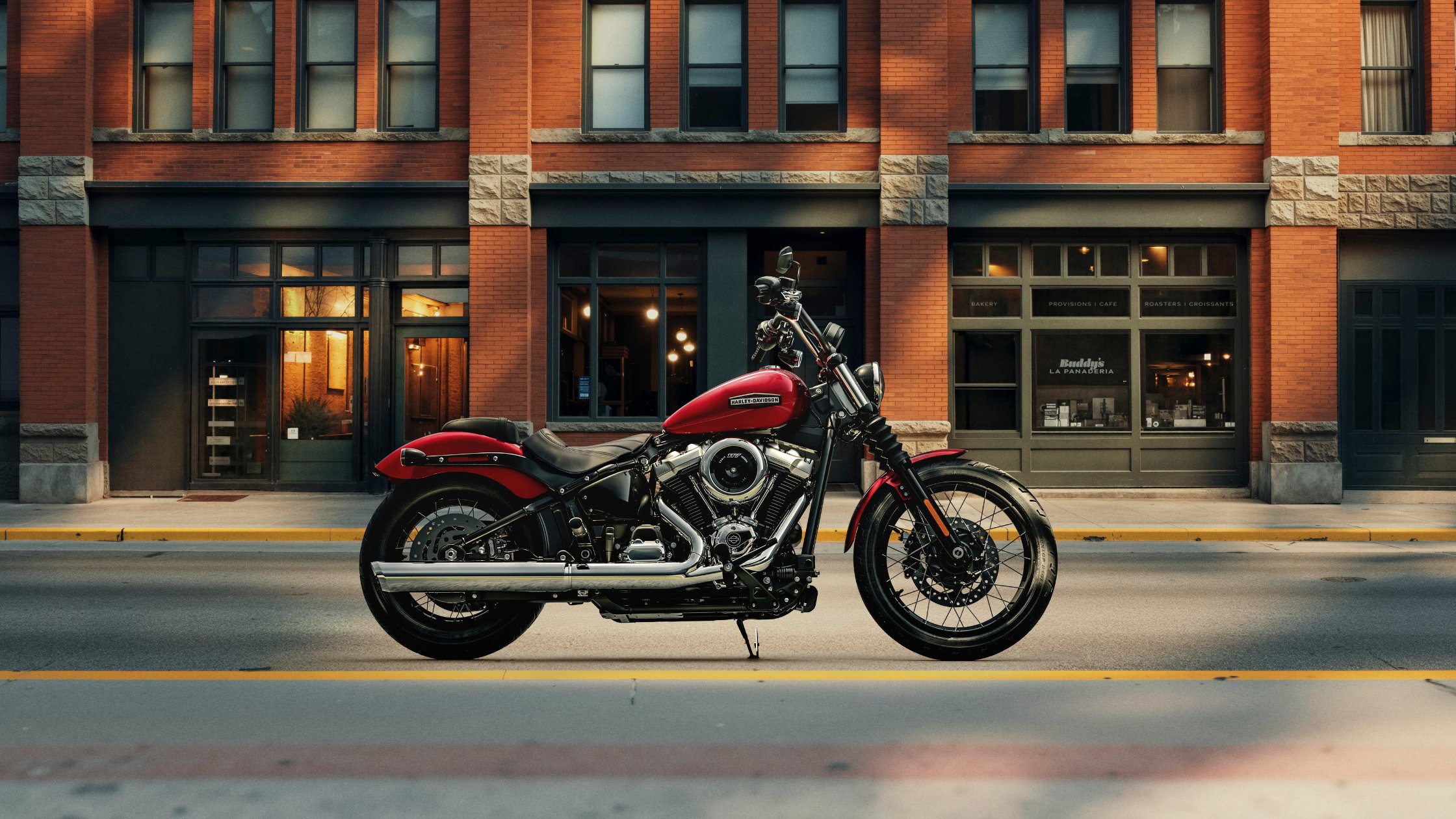
The 2026 Harley-Davidson® Street Bob® is engineered as a performance-oriented cruiser that integrates a large-displacement V-twin engine with a structurally rigid chassis and a simplified rider interface. The design emphasizes mechanical efficiency, predictable handling characteristics, and consistent system integration across engine, drivetrain, suspension, and braking components. The motorcycle uses a Milwaukee-Eight® 117 Classic engine paired with a 6-speed transmission and a belt-driven final drive, supported by a tubular steel frame and modern rider safety systems. Its configuration prioritizes torque delivery, stability, and rider control through carefully defined geometry and calibrated electronic assistance.
Engine Configuration and Output Characteristics
The 2026 Harley-Davidson® Street Bob® is powered by a Milwaukee-Eight® 117 Classic engine with a displacement of 1,923 cc. The engine uses a bore of 4.075 inches and a stroke of 4.5 inches, creating a long-stroke design that supports strong torque output at lower engine speeds. The compression ratio is set at 10.3:1, balancing combustion efficiency with consistent power delivery across the operating range.
The engine produces 120 ft-lb of torque at 2,500 rpm and 98 horsepower at 4,600 rpm. This output supports steady acceleration and sustained cruising performance. The valve train uses pushrod-operated overhead valves with hydraulic self-adjusting lifters. Each cylinder includes four valves, which improve airflow and combustion efficiency.
Fuel delivery is managed through Electronic Sequential Port Fuel Injection, which meters fuel precisely based on engine load and throttle input. The air intake system includes a 9-inch round air cleaner with a washable fiberglass filter element. The exhaust system is configured as a 2-into-1 layout with a catalyst integrated into the header, supporting emissions compliance and controlled exhaust flow.
The lubrication system uses a pressurized dry-sump design with an oil cooler. This configuration maintains stable oil circulation and temperature control under varying operating conditions.
Transmission and Drivetrain Calibration
The drivetrain combines a chain-driven primary system and a belt-driven final drive. The primary drive uses a 34/46 ratio, while the final drive uses a 32/66 ratio. This arrangement provides efficient torque transfer while reducing maintenance requirements compared to fully chain-driven systems.
The transmission is a 6-speed Cruise Drive® unit designed to support both low-speed maneuverability and highway cruising. Gear ratios are calibrated to provide progressive acceleration through each gear. First gear has a ratio of 9.311, while sixth gear is set at 2.79, allowing a lower engine speed during sustained travel.
A mechanical 10-plate wet clutch with assist functionality is used to manage power transfer between the engine and transmission. This clutch design reduces lever effort and improves engagement consistency.
Structural Frame and Geometry Specifications
The frame uses a mild steel tubular construction with a rectangular section backbone. The structure incorporates stamped, cast, and forged junctions that are MIG welded to ensure strength and rigidity. Aluminum forged fender supports reduce overall weight while maintaining structural integrity.
The swingarm is constructed from mild steel tubular sections and includes a stamped cross-member and forged axle junctions. A removable belt spacer is integrated into the design for ease of maintenance and alignment adjustments.
The motorcycle has a rake angle of 30 degrees and a trail measurement of 6.2 inches. The wheelbase measures 64.2 inches. These dimensions contribute to stable straight-line performance and controlled steering response. The geometry is designed to balance maneuverability with directional stability.
Suspension System Design and Travel
The front suspension uses a 49 mm telescopic fork with dual-bending valve technology. This system improves damping control by adjusting to varying road inputs. Dual-rate springs are used to provide consistent performance under different load conditions. The fork assembly includes aluminum triple clamps and gaiter covers.
The rear suspension uses a hidden coil-over monoshock with a free piston design. The shock provides 43 mm of stroke and includes cam-style preload adjustment. This allows the rider to adjust suspension settings based on load requirements. The rear suspension is positioned to maintain a low-profile appearance while delivering consistent damping performance.
Suspension travel measures 5 inches in the front and 3.4 inches in the rear. This range supports controlled absorption of road irregularities while maintaining stability and ride balance.
Braking System and Control Systems
The braking system uses a 4-piston fixed caliper on the front wheel and a 2-piston floating caliper on the rear wheel. Both front and rear brakes use solid rotors with uniform expansion characteristics. The front rotor measures 11.8 inches in diameter, while the rear rotor measures 11.5 inches.
An anti-lock Braking System is included as standard equipment. The system prevents wheel lock during braking events and supports consistent deceleration under varying traction conditions.
The motorcycle also includes traction control and drag-torque slip control systems. These systems manage rear-wheel traction during acceleration and deceleration. The traction control system adjusts engine output when wheel slip is detected, while the drag torque slip control system reduces rear wheel instability during aggressive downshifting.
Cornering-enhanced versions of these systems are included. Cornering Enhanced ABS, Cornering Enhanced Traction Control, and Cornering Drag-Torque Slip Control adjust system responses based on lean angle and dynamic inputs. These systems improve stability during cornering maneuvers.
The Tire Pressure Monitoring System provides continuous monitoring of tire pressure levels and alerts the rider when deviations occur.
Wheels, Tires, and Contact Patch Configuration
The 2026 Harley-Davidson® Street Bob® uses cast aluminum wheels identified as the Annihilator style. The front wheel measures 19 inches in diameter and 2.5 inches in width. The rear wheel measures 16 inches in diameter and 3 inches in width. The wheel design reduces unsprung weight while maintaining structural durability.
The motorcycle is equipped with Dunlop® Harley-Davidson® Series bias-ply tires. The front tire specification is 100/90B19, while the rear tire specification is 150/80B16.
Dimensions, Weight, and Ergonomic Layout
The overall length of the motorcycle is 91.3 inches, with a width of 36.4 inches and a height of 45.7 inches. The seat height measures 25.8 inches when laden and 26.8 inches when unladen. This configuration supports a low center of gravity and improved rider reach to the ground.
Ground clearance is measured at 4.9 inches. Lean angles are rated at 28.5 degrees on both the left and right sides. These measurements support controlled cornering performance without excessive chassis contact.
The motorcycle has a running weight of 646 pounds. Weight distribution and frame geometry contribute to stability during operation. The Gross Vehicle Weight Rating is 1,160 pounds, supporting rider and cargo capacity within defined limits.
Electrical System and Instrumentation Interface
The electrical system uses a sealed, maintenance-free AGM battery rated at 12 volts and 17.5 amp-hours, with 310 cold cranking amps. Charging is managed through a three-phase 48-amp system, providing consistent electrical output across varying engine speeds.
The starting system uses a 1.6 kW electric starter with solenoid engagement. Lighting components use LED technology for all primary functions, including headlamp, taillamp, and turn signals. The headlamp includes a low beam, a high beam, and a signature position light.
Instrumentation is provided through a 4-inch analog speedometer with an integrated digital display. The display provides information including gear position, odometer, fuel level, ride modes, traction control status, ABS indicators, tire pressure monitoring, cruise control status, clock, trip data, range estimation, and tachometer readings.
A USB-C power outlet is included, delivering 5 volts at 2.4 amps for device charging. No integrated infotainment system, navigation, or Bluetooth® connectivity is included, maintaining a simplified interface focused on essential operational data.
Fuel Capacity and Efficiency Metrics
The fuel tank has a capacity of 3.5 gallons, with a reserve capacity of approximately 1 gallon indicated by a warning light. This capacity supports extended riding intervals without frequent refueling.
Fuel economy is estimated at 47 miles per gallon under combined city and highway conditions. This efficiency is supported by the fuel injection system and engine calibration.