
2026 Harley-Davidson® CVO™ Street Glide® ST near Evans, GA
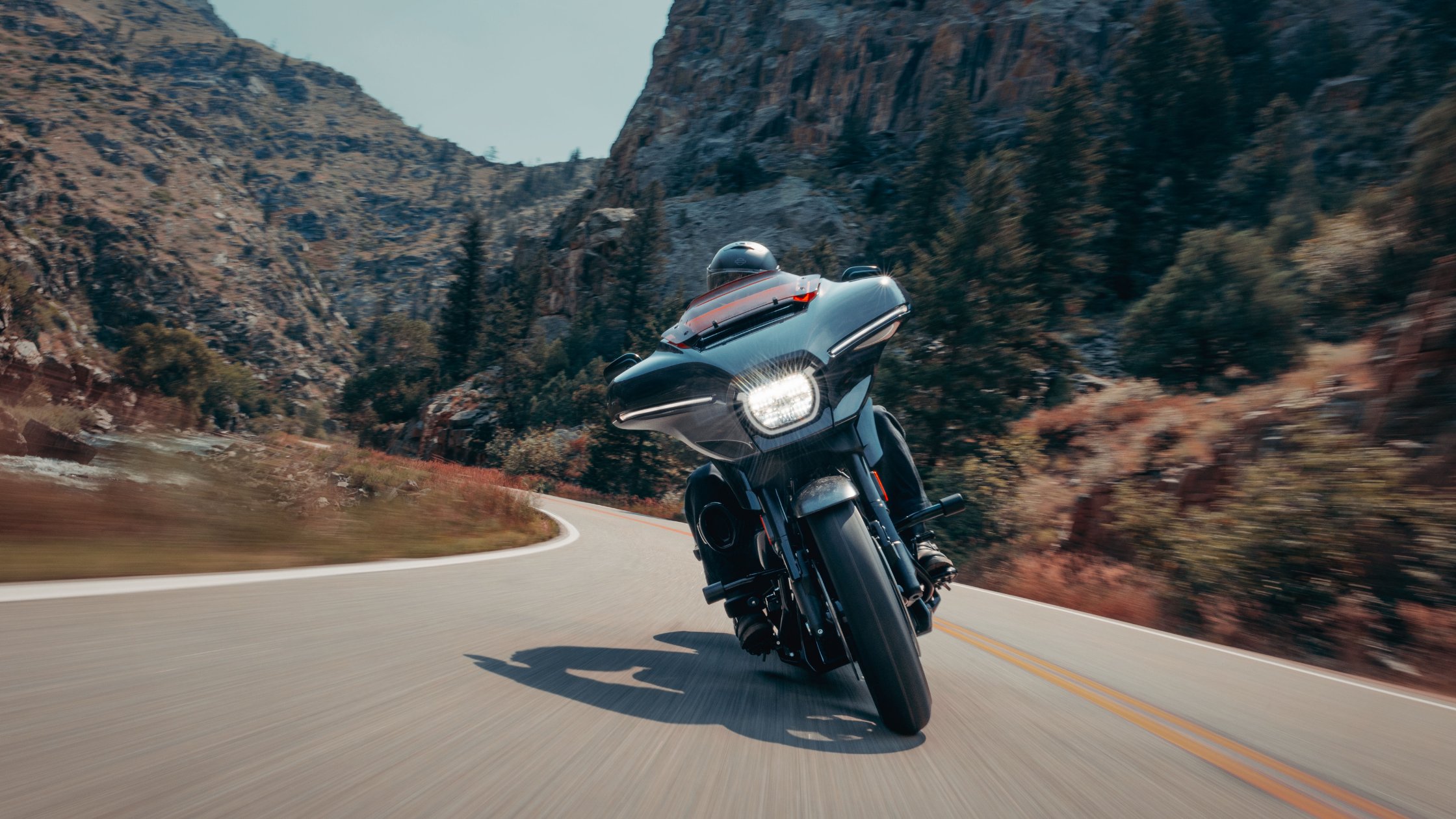
The 2026 Harley-Davidson® CVO™ Street Glide® ST by Harley-Davidson® is a performance-focused touring motorcycle designed with measurable engineering priorities. The model combines a high-displacement powertrain, sport-oriented chassis geometry, advanced braking systems, and integrated electronic technologies intended to support rider control and long-distance functionality. The motorcycle measures 94.9 inches in length, 38.6 inches in width, and 52.4 inches in overall height, establishing a substantial touring profile while maintaining balanced proportions for handling stability. Seat height measures 27.5 inches in laden configuration and 29.1 inches unladen, supporting stable rider positioning during operation. The 64-inch wheelbase and 26-degree rake contribute to directional consistency, while the 6.7-inch trail supports predictable steering response during both straight-line riding and corner transitions.
The platform uses a mild steel tubular frame with cast and forged junctions, engineered for rigidity and load management. This structure supports high torque output and sustained highway operation while maintaining chassis alignment under acceleration and braking loads. The model’s technical package emphasizes mechanical precision and operational consistency rather than decorative enhancements.
Engine Architecture and Performance Output
The engine installed in the 2026 Harley-Davidson® CVO™ Street Glide® ST is the Milwaukee-Eight® 121 High Output. This pushrod-operated engine uses overhead valves with hydraulic self-adjusting lifters and four valves per cylinder. Displacement measures 121 cubic inches, with a bore of 4.075 inches and a stroke of 4.625 inches. The compression ratio stands at 11.4:1, supporting efficient combustion and steady power production across the operating range.
Fuel delivery occurs through Electronic Sequential Port Fuel Injection, allowing precise control of air and fuel mixture. The intake system includes a fiberglass washable air cleaner, designed for airflow efficiency and practical service intervals. Exhaust routing uses a 2-1-2 dual exhaust configuration with tapered mufflers, balancing exhaust pressure and acoustic output while supporting engine breathing requirements. The lubrication system uses a pressurized dry-sump arrangement, which helps maintain oil supply stability during acceleration, cornering, and prolonged operation.
Performance testing indicates a peak output of 127 horsepower at 4,900 rpm and engine torque of 145 ft-lb at 4,000 rpm. These figures position the motorcycle within a high-performance touring category, where torque delivery supports strong acceleration without frequent shifting. The engine configuration is designed to maintain consistent mechanical operation during extended riding durations and variable throttle conditions.
Transmission and Drivetrain Configuration
Power delivery moves through a mechanically actuated 10-plate wet clutch equipped with Assist and Slip functionality. This system reduces clutch lever effort while managing driveline stability during aggressive downshifting. The primary drive uses a chain system with a 34/46 ratio, while final drive transmission occurs through a belt with a 30/68 ratio. This layout combines durability with reduced maintenance requirements.
The 2026 Harley-Davidson® CVO™ Street Glide® ST utilizes a 6-Speed Cruise Drive® transmission. Gear ratios are arranged to provide controlled acceleration in lower gears and reduced engine speed during highway cruising in sixth gear. The overall ratios include 10.233 in first gear, 7.093 in second, 5.268 in third, 4.266 in fourth, 3.635 in fifth, and 3.067 in sixth. This progression supports smooth power transfer and stable engine operation across varied speeds.
The drivetrain design maintains alignment between engine output and rear wheel traction while minimizing abrupt mechanical transitions. Riders experience predictable responses during acceleration and deceleration due to the coordinated interaction between the clutch, transmission, and final drive system.
Chassis Engineering and Suspension Design
The frame uses a two-piece stamped and welded backbone with twin down-tubes and forged junctions. The swingarm consists of a mild steel two-piece drawn and welded structure with reinforced junctions. These components are assembled using MIG welding techniques to maintain structural consistency.
The front suspension employs 47 mm inverted forks with adjustable preload, compression damping, and rebound damping. Rear suspension uses emulsion shocks with matching adjustability. Suspension travel measures 4.6 inches in the front and 3 inches in the rear. This configuration allows adjustment for rider preference, passenger load, or luggage weight while maintaining controlled movement through uneven surfaces and cornering loads.
Ground clearance measures 5.3 inches, contributing to lean angles of 31 degrees on both the left and right sides. These measurements indicate a geometry focused on sport-influenced handling within a touring platform. Adjustable damping components allow modifications to ride behavior while maintaining structural stability.
Wheel, Tire, and Brake System Specifications
The 2026 Harley-Davidson® CVO™ Street Glide® ST rides on black 7-spoke cast aluminum wheels. The front wheel measures 19 inches in diameter with a width of 3.5 inches, while the rear wheel measures 18 inches with a 5-inch width. Tires are Dunlop® Harley-Davidson® Series bias blackwall models, using a D408F front specification of 130/60B19 and a D407T rear specification of 180/55B18.
Braking components include dual front radial-mounted 4-piston fixed calipers combined with wave-style floating rotors measuring 12.6 inches in diameter. The rear brake uses a single axial-mounted caliper with an 11.8-inch rotor. Rotor thickness measures 0.18 inches at the front and 0.28 inches at the rear. Anti-lock Braking System functionality is included as standard equipment.
This braking configuration supports controlled deceleration and consistent pressure distribution across contact points. The dual front rotor arrangement increases stopping efficiency while helping maintain stability under load transfer during braking events.
Electrical System and Lighting Integration
Electrical power is managed through a sealed, maintenance-free 12V battery rated at 28 amp-hours with a 405 CCA output. Charging occurs through a three-phase 58-amp system capable of producing up to 754 watts at 13 volts. Starting is handled by a 1.6 kW electric starter with solenoid shift engagement.
Lighting systems use LED technology across major functions, including headlamps, tail and stop lights, and front and rear signal lights. LED components reduce power consumption and improve illumination consistency compared with conventional bulbs. Digital gauges are integrated within the main display, eliminating separate analog instrumentation and centralizing vehicle information.
A USB-C electric power outlet rated at 15 watts is integrated into the media storage box, allowing charging or accessory connection during operation. The electrical layout supports infotainment functions and rider interface systems without excessive power draw.
Infotainment and Connectivity Systems
The 2026 Harley-Davidson® CVO™ Street Glide® ST uses the Skyline™ OS infotainment platform, displayed on a 12.3-inch full-color TFT screen. The system includes AM and FM radio, Bluetooth® phone and media connectivity, and Apple CarPlay® compatibility through wireless or wired connection. Audio output delivers 125 watts per channel through two 6.5-inch fairing-mounted speakers.
USB-C and MTP connectivity support external media playback and smartphone integration. The display also provides vehicle information, including air temperature, oil pressure, and EITMS monitoring. Navigation capability is integrated through an embedded GPS system with map guidance and connectivity-based updates.
Hands-free mobile phone functionality supports rider communication, and headset pairing is available for intercom use when compatible equipment is installed. The infotainment structure centralizes data access while reducing reliance on external devices mounted to the handlebars.
Safety Technology and Rider Control Systems
The 2026 Harley-Davidson® CVO™ Street Glide® ST incorporates multiple rider safety enhancement systems designed to assist stability and traction management. Anti-lock Braking System, Electronic Linked Braking, Traction Control System, Drag-torque Slip Control System, Vehicle Hold Control, and Tire Pressure Monitoring System are included. These systems operate through sensor-based inputs that monitor wheel behavior and rider commands.
Cornering-enhanced variants of braking and traction systems extend functionality during lean angles. Cornering-enhanced ABS, Cornering Electronic Linked Braking, Cornering Traction Control, and Cornering Drag-torque Slip Control adjust system intervention based on lean and vehicle orientation. This configuration aims to maintain predictable handling when braking or applying throttle while cornering.
These systems function in coordination with the chassis and braking hardware to support stability without replacing rider control input. The technology package focuses on maintaining mechanical balance during varying surface conditions and riding maneuvers.
Fuel Capacity, Efficiency, and Operational Specifications
Fuel capacity totals 6 gallons with an additional reserve indication of approximately 1 gallon through the fuel injection warning system. Oil capacity measures 5 quarts with filter, transmission capacity measures 1 quart, and primary chain case capacity is 1.1 quarts. Coolant capacity is rated at 0.82 quarts.
Weight measurements include 782 pounds as shipped and 816 pounds in running order. Gross vehicle weight rating is listed at 1,360 pounds, supporting rider, passenger, and cargo loads. Luggage capacity measures 2.42 cubic feet, providing practical storage volume for touring usage.
Fuel economy is estimated at 44 mpg in combined city and highway conditions. This figure reflects efficiency considerations alongside performance output and engine displacement.